 |
|
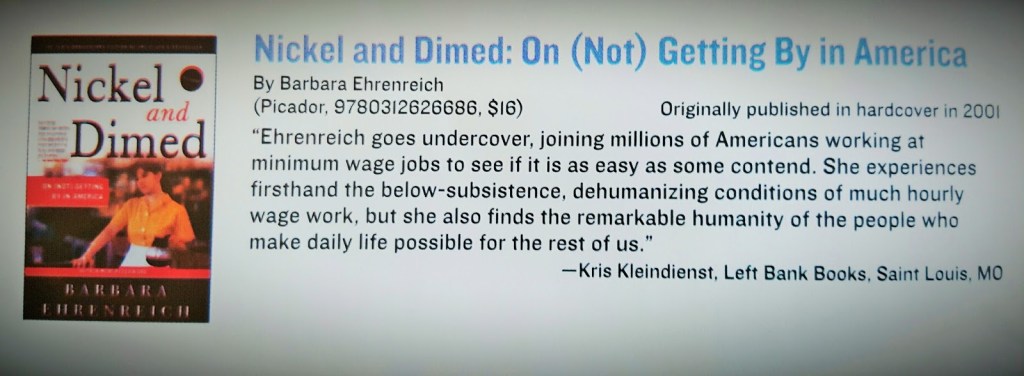
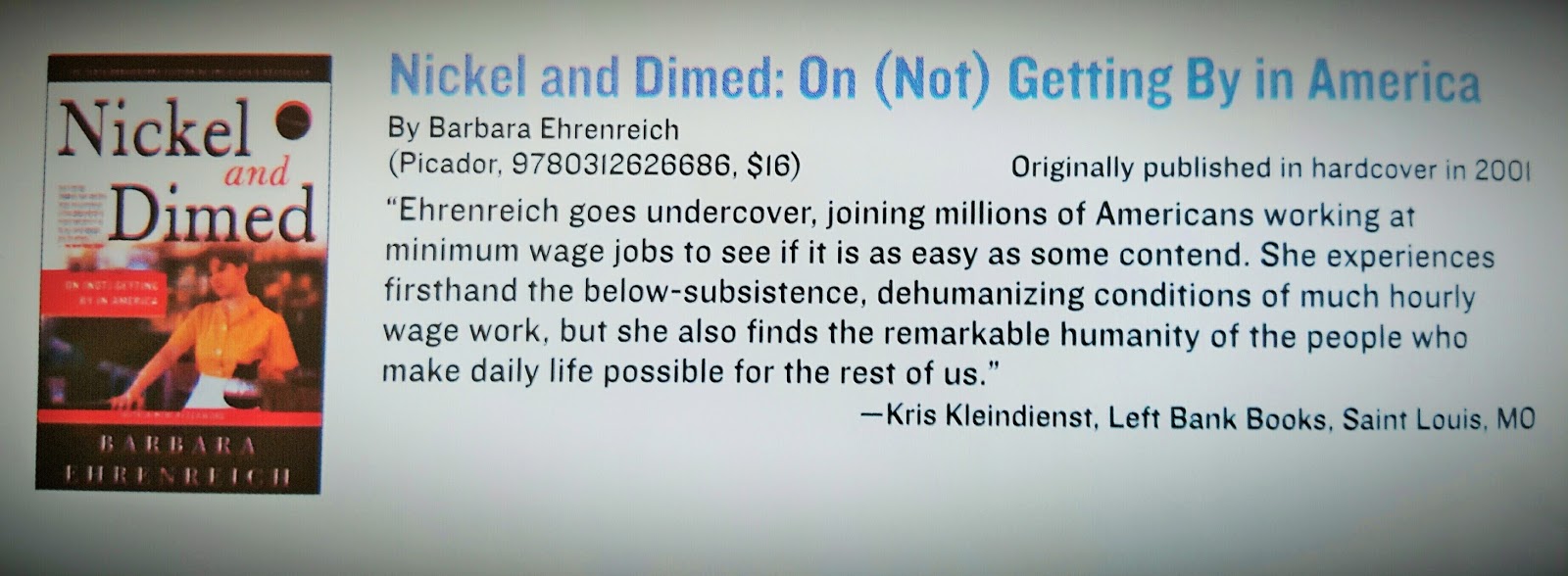
The blurb in question. |
It’s like being poor is a conspiracy or something. Let’s go undercover and make sure poverty is a real thing! Because maybe the destitute are big, fat liars? They’re not “us,” after all, how can we be sure “they” can be trusted?
As if living in fear of nearly everything, from sleeping in your car (if you’re lucky enough to have one) to wondering if you have enough Ramen to last til next payday, isn’t enough; there’s now a book that allows the privileged to read about how craptastic life can be. Yay for them. Or us. Or whoever’s side you happen to be on.
Apparently there are sides.
At least that’s what I gleaned after picking up the January 2016 Indie Next List at the local bookstore in Pacific Grove over the weekend. While this post has nothing to do with the book “Nickel and Dimed: On (Not) Getting By in America,” by Barbara Ehrenreich, it has everything to do with the book’s absurd listing in the List. Initially, the premise had me interested. That is until I read the description. The short blurb by Kris Kleindienst, Left Bank Books, Saint Louis, MO, is as follows:
“Ehrenreich goes undercover, joining millions of Americans working at minimum wage jobs to see if it is as easy as some contend. She experiences firsthand the below-subsistence, dehumanizing conditions of much hourly wage work, but she also finds the remarkable humanity of the people who make daily life possible for the rest of us.”
And never has a short, pretentious review steered me so far from wanting to read a book before now.
There’s a silver lining to poverty? Of course there is. Those who’ve never faced the misery of hunger need that silver lining. It wouldn’t be a good read without a kernel of uplifting drivel. Of course for those of “us” who know poverty, there really is no silver lining. Remarkable humanity? Is it surprising that poor people can be nice? Surprising to whom? The rich? The Clintons? To Conservatives? And going undercover to see what want is like? Knowing you can return to a life of iPhones and Netflix, car payments and vacations to Hawaii, or whatever, takes the edge off fearing you might die hungry and alone in cardboard box. You’re just pretending, knowing you can drive off in a Lexus when it gets too nasty to handle.
It’s the last sentence that stirred my ire the most. The poor make daily life possible for the rest of us? That statement, of course, assumes a great deal. It assumes poor people would never pick up this book and that anyone who might want to read it just needs assurances they will never have to hang their laundry in the backyard or call the food bank to see what time they close. As a reader, as someone who has never been rich and has, on more than one occasion, planned to live in the backseat of a car should the next paycheck go sideways, I don’t appreciate being lumped into the “us” category. There is no us and them when it comes to poverty. For some, it’s a spouse who thankfully makes a good wage, for others it’s parents who help out their middle-aged children, and for others it’s an abyss with no safety net.
We are them. They are us. End of story.


 Patrick Whitehurst
Leave a comment